


Disposable Cotton Napkins
Disposable cotton napkins is a revolution of traditional textiles, modern technology makes napkin goodbye to sewing.
Description
Your Leading Disposable Cotton Napkins Manufacturer
Shaoxing Shining Textile Co.,Ltd: We specialize in cotton textiles for 20 years, providing safe, environmentally friendly and high-temperature-resistant cotton home textile products to global suppliers
100% Eco-Friendly
Our products are made of sustainable materials such as cotton, linen, etc., which is part of our green practices to shoulder social responsibility. These products are can be 100% recycled after use and won't last a lifetime in the landfill.
Customizable
We provide global customers with OEM&ODM services. We can offer our colors and patterns for customers to choose. Or the customer provides an idea and we implement it for you.
Wide Applications
All of our products are not only suitable for daily use, but also for holiday gatherings, weddings, parties, banquets, and restaurant operations.
Quality Assurance
We have passed BSCI, OEKO-TEX and other certificates. And our company has won the trust and support of customers all over the world with high-quality products and first-class after-sales service.
Disposable cotton napkins
Origin and significance
Based on the idea of creating a better life, with 20 years of experience in textile industry, after 3 years of independent research and development, our company produces napkins with completely independent intellectual property rights
Disposable cotton napkins is a revolution of traditional textiles, modern technology makes napkin goodbye to sewing.
Global warming and COVID-19 are the earth's warning to mankind that we must accept a low-carbon, environmentally friendly and hygienic lifestyle
Choose disposable cotton napkins, which is a reflection on the way we used to live, is a new minimalism.
Disposable cotton napkins changed life much better
Product Advantage

Reduced Exposure to Chemicals
Ordinary disposable napkins are made with chemicals to look whiter and stronger. Choosing cotton napkins means we can avoid these chemicals, keeping us and our families safer. Therefore, using cotton napkins when dining helps us stay away from harmful substances.

Hypoallergenic
Cotton napkins are a smart choice for people with skin that is prone to irritation or allergies. Because cotton is non-allergenic, it is less likely to irritate your skin than the dyes and chemicals in paper towels. This makes it a great choice for those who want a napkin that is gentle on the skin when dining.

More Comfortable and More Absorbent
Cotton's natural softness and ability to absorb liquids make it the best choice for cleaning your face and hands gently and effectively. This means that cotton not only feels better, but it also cleans messes well. Soft, absorbent napkins can gently handle spills, making mealtimes more enjoyable.

Sustainable and Reduces Waste
These napkins can be used multiple times, and because you can wash them, it means you won't be throwing away as much. When we use less disposable napkins, we help keep the planet clean. And a clean planet means healthier air and water for all of us.
types of Disposable Cotton Napkins
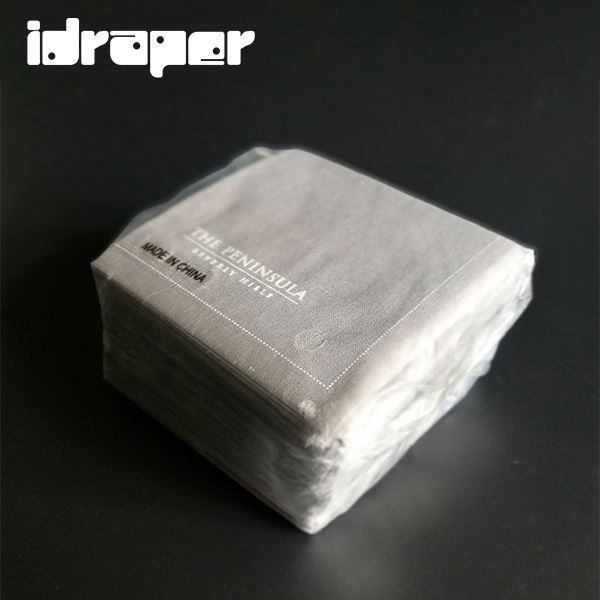
Tear-Off Napkins:
These napkins are usually sold in rolls, and users can tear off the appropriate length of napkins as needed. They are usually highly absorbent and suitable for various dining occasions. For example, 11.4×11.4 printed tear-off cotton napkins, 11.5×11.5cm patterned tear-off napkins, etc.
Coaster Napkins:
These napkins are usually designed to be smaller and can be used as coasters, but can also be used as small napkins. They usually have a variety of colors and patterns to choose from, suitable for occasions such as homes and restaurants. For example, 10×10cm tear-off cotton coaster napkins, colored tear-off napkins, etc. Rolled Tablet Napkins: These napkins are presented in rolls, and a complete napkin can be torn off when used. They are usually soft and absorbent, suitable for various dining and cleaning occasions. For example, new cotton napkin rolls, tear-off roll napkins, etc.
Personalized Napkins:
These napkins can be customized according to customer needs, such as printing specific patterns, text or logos, etc.
They are suitable for special occasions such as weddings, restaurants, corporate events, etc. to increase the atmosphere and personalization of the event.
For example, customized personalized cotton napkins, wedding tear-off napkins, etc.
Placemat Napkins:
These napkins are usually larger and can cover the entire plate or tabletop, playing a role in protecting the tabletop and decoration.
They are usually highly absorbent and can also be used as napkins.
For example, 32×48cm tear-off placemat napkins, etc.

Material of Disposable Cotton Napkins

Pure cotton
Disposable cotton napkins made of pure cotton are popular among consumers for their good water absorption, softness and breathability.
Pure cotton napkins are usually comfortable to the touch and will not irritate the skin, suitable for people of all skin types.
Polyester
Polyester is a synthetic fiber with good wear resistance, wrinkle resistance and elasticity.
Some disposable cotton napkins may use a blend of polyester and cotton to combine the advantages of both and improve the durability and practicality of the napkins.
In addition to the above main materials, disposable cotton napkins may also contain some auxiliary materials, such as:
Bamboo fiber
Bamboo fiber has natural antibacterial, anti-mite and anti-odor properties, which can increase the hygiene of napkins.
Bamboo fiber and cotton blended napkins are also common in the market.
Graphene
Graphene is a new type of nanomaterial with excellent thermal conductivity and antibacterial properties.
In some high-end disposable cotton napkins, graphene may be added to enhance its antibacterial and breathable properties.

Application of Disposable Cotton Napkins

Disposable cotton napkins are often used for cocktail parties, weddings, restaurants, and other catered events. They are designed to be strong and durable, while still being disposable for quick and easy cleanup.
Here are some other uses for cotton napkins:
Cooking prep: Use them for mealtime or cooking prep.
Household chores: Use them for tasks like drying dishes, wiping counters, dusting, and more.
Gift wrapping: Use them to wrap gifts instead of disposable paper.
Herbs: Wrap used napkins around herbs to keep them fresh longer.
Fridge lining: Place them on the shelves of your fridge to absorb moisture and catch crumbs.
Dog bandana: Turn them into fashionable dog bandana scarves.
Coasters: Use small cocktail napkins as coasters.
Under potted plants: Layer a folded table napkin or cocktail napkin under potted plants to protect wooden surfaces.
Pocket square: Wear a cloth napkin as a pocket square.

Process of Disposable Cotton Napkins
Regarding the production process of disposable cotton napkins, it usually involves multiple steps, from raw material preparation to finished product packaging, and each link is crucial. The following is an overview of the production process of disposable cotton napkins:

1. Raw material preparation
Cotton procurement: Select high-quality cotton as raw material to ensure the softness, absorbency and durability of the napkins.
Chemical treatment (if applicable): In some cases, cotton may need to be chemically treated to increase its fiber strength or improve other properties. However, this step may not be necessary for disposable cotton napkins because they usually focus more on comfort and absorbency.
2. Fiber preparation
Cotton combing: The cotton fibers are combed to remove impurities and short fibers and make the fibers more uniform.
Fiber blending (if applicable): If blended napkins need to be produced, different types of fibers (such as polyester fibers, bamboo fibers, etc.) can be mixed.
3. Papermaking process
Pulp preparation: The combed cotton fibers (or blended fibers) are mixed with water to form pulp.
Paper machine forming: The pulp is passed through the paper machine's mesh cage or blanket so that the fibers are interwoven into a paper web on the mesh surface.
Pressing and drying: The paper web is pressed to remove excess water, and then dried to the appropriate humidity through a drying device.
4. Post-processing
Embossing and folding: The napkins are embossed using an embossing machine to increase their beauty and feel. Then, the napkins are folded into the desired shape and size.
Cutting and packaging: The napkins are cut into individual products using a cutting machine and packaged. Packaging materials may include plastic bags, paper boxes, etc., depending on customer needs and product design.
5. Quality control and inspection
Appearance inspection: Check whether the appearance of the napkin is flat, undamaged, stain-free, etc.
Performance testing: The napkins are subjected to performance tests such as water absorption, softness, durability, etc. to ensure that they meet quality standards.

6. Finished product storage and delivery
Finished product storage: Store the qualified napkins in a dry and ventilated warehouse to prevent moisture and contamination.
Shipping: According to customer orders, the napkins are packaged, boxed and shipped to the designated location.
In summary, the production process of disposable cotton napkins involves multiple links, and strict quality control is required from raw material preparation to finished product packaging. By optimizing the production process and adopting advanced production equipment, the production efficiency and product quality of napkins can be improved to meet consumer needs.
What you should know when use Disposable Cotton Napkins
Here are some things to know about disposable cotton napkins:
Convenience: Disposable cotton napkins are convenient and high-end, but they can't be washed multiple times like traditional cotton napkins.
Environmental impact: Using disposable cotton napkins can reduce your environmental impact by cutting back on single-use napkins.
Health benefits: Cotton napkins are a good choice for people with sensitive skin or allergies because they don't trigger allergies. They can also be used to gently wash your hands and face.
Absorbency: Cotton napkins are more absorbent than paper napkins.
Texture: Cotton napkins have a nicer texture than paper napkins.
Appearance: Cotton napkins can make your table look more elegant.
Organic cotton: Organic cotton is more eco-friendly than conventional cotton because it produces fewer greenhouse gas emissions and has less impact on water pollution.


who choose us?
Shaoxing Shining Textile Co., Ltd. is a company integrates industry and trade .
We focusing on cotton textiles for 20 years to supply safe and environmentally friendly cotton textiles for global customers.
To provide customers with R & D, production, import and export services;
To provide customers with disposable cotton napkin one-stop solution.
Company has a superb team who devote themselves to providing the best possible quality and service. Our every worker has more than 10 years experience. We trust expertise and professional integrity are keys to its rapid progress.
The company has established a win-win relationship with our customers as a result of the joint efforts from the team members and the global buyers.
one-stop solution
professional team
high quality


FAQS
Q: How to use a paper napkin?
Q: How to sanitize napkins?
Q: What is napkin etiquette?
Q: What are disposable napkins made of?
Q: What are cotton napkins used for?
Q: How do you wash cotton napkins?
Q: Do cotton napkins wrinkle?
Q: How do restaurants get their napkins so white?
Q: What is the best color for napkins?
Q: Should your napkins match your tablecloth?
Q: Where is the best place to put napkins?
The napkin always goes to the left of the dinnerware... ...
Place your flatware in the order they will be used, with the items that will be used first on the outside.
Forks go to the left of the plate, and knives and spoons go on the right.
Q: Why use cotton napkins?
Q: Does anyone use tablecloths anymore?
Q: Where do you place your napkin once you've finished eating?
Q: What are the things to avoid when using table napkin?
1. Do Not Tuck the Napkin into Your Collar
2. Do Not Use the Napkin to Clean Cutlery or Dishes
3. Do Not Place a Used Napkin on the Table During the Meal
4. Do Not Wave or Gesture with the Napkin
5. Do Not Ball Up the Napkin
Q: What to look for when buying napkins?
Q: How do you wash cotton cloth napkins?
Q: What is the tablecloth trick?
Q: What is the best color for napkins?
Q: Should napkins be same color as tablecloth?
Q: Where is the best place to put napkins?
The napkin always goes to the left of the dinnerware... ...
Place your flatware in the order they will be used, with the items that will be used first on the outside.
Forks go to the left of the plate, and knives and spoons go on the right.
Q: What type of cotton is best for napkins?
Hot Tags: disposable cotton napkins, China disposable cotton napkins manufacturers, suppliers, Party Napkin, Dinner Napkin, Cotton Dinner Napkins, Jingle Bells Napkins, Disposable Cotton Dinner Napkins, Cloth Dinner Napkins Bulk
Send Inquiry
You Might Also Like


